
//ZAKA's Adaptive Knowledge Hub
Adaptive Knowledge Hub
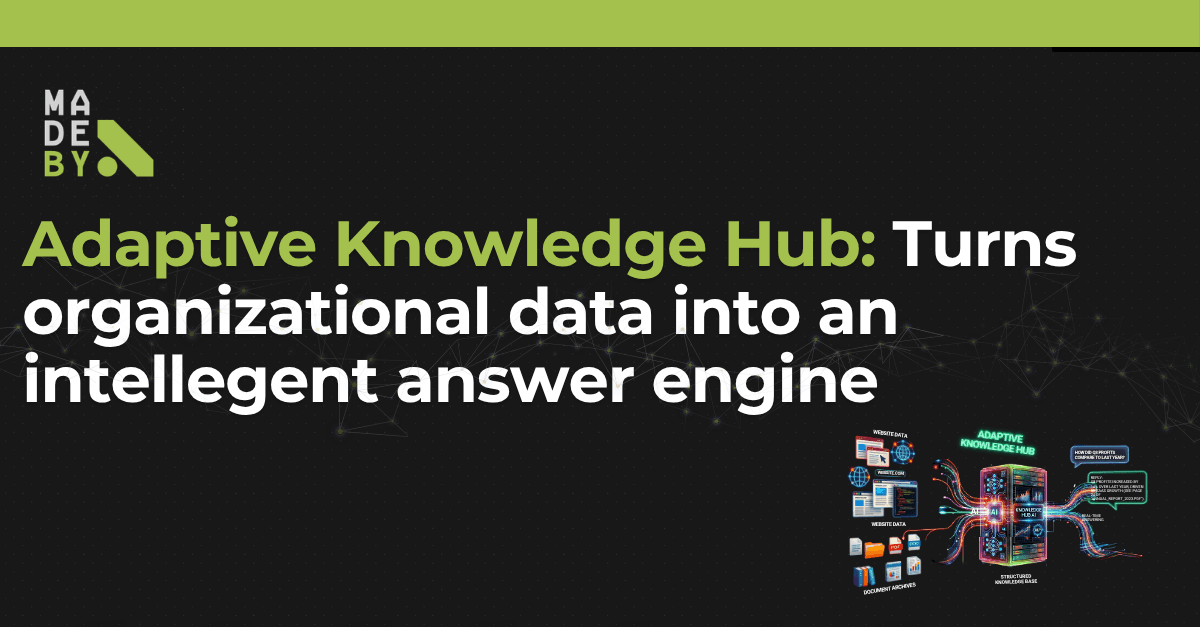
The Adaptive Knowledge Hub is an AI powered platform designed to turn an organization's scattered information into a single, intelligent answer engine.
Most question answering tools handle one source well and everything else badly. They cover documents but not live data, websites but not spreadsheets, English but not Arabic. Real organizational knowledge is rarely that clean. To solve this, we built a unified platform that brings together every flavor of information a business actually uses, including official documents, scanned PDFs, internal websites, live spreadsheets, and trusted external sources, and lets anyone ask questions in natural language across all of them at once.
Below is a closer look at what the Adaptive Knowledge Hub looks like in practice and what each part of it does for the teams using it.
The Dashboard
The first thing that greets an operator on the Adaptive Knowledge Hub is a dashboard that summarizes the entire knowledge base at a glance. It shows how many web pages have been indexed, how many internal documents have been processed, how many embeddings are available for retrieval, and how many live data sources are connected. From here, operators can jump straight into adding new sources, generating an API key for an integration, or rebuilding the index after a major content update. The whole experience is designed so that someone with no technical background can understand the state of the knowledge base in a few seconds.

Bringing in Knowledge from Websites
Websites are usually where the most current public information about an organization lives. The Adaptive Knowledge Hub treats them as a primary source of knowledge. Operators can submit a website by entering its address, and the platform crawls the entire site responsibly, page by page, indexing every accessible page so that each one becomes searchable inside the system. For more targeted ingestion, individual links can also be submitted on their own without needing to crawl the entire domain. Once the indexing is complete, the platform shows the full list of pages that were captured, along with their status and the last time each one was refreshed.

Adding Documents and Files
Not all knowledge lives on the web. Internal handbooks, policy documents, reports, training material, and presentations often hold the answers a team needs the most. The Adaptive Knowledge Hub lets teams upload these directly through the admin console, including PDFs, Word documents, slide decks, spreadsheets, plain text, Markdown, and even scanned documents. Each file is read, broken into meaningful chunks, and indexed alongside the website content, so that a question asked in natural language is answered from both sources at once when it makes sense to do so. Whether the answer is sitting in a public blog post or buried inside an internal training PDF, the platform finds it.

Live Sheets and Real Time Data
Some information changes too often to be embedded into a static index. Prices, schedules, course availability, and inventory all need to reflect the current state of the world rather than a snapshot from last week. For these cases, the platform supports live spreadsheets connected directly to Google Sheets or uploaded as files. The structure of the sheet is registered in the system so that the platform knows when to consult it, and the actual values are pulled in real time at the moment a question is asked. The result is an assistant that can answer pricing or availability questions with the same accuracy as your most up to date spreadsheet.
Bilingual and Conversational
The platform is built to work fluently in both English and Arabic, including Arabizi, the popular informal style of writing Arabic in Latin characters. Questions can come in any of these forms and the assistant responds in the same style the user wrote in, which makes it feel natural for audiences across the region. The platform also remembers the conversation, so follow up questions like "are you sure?" or "what about the next one?" are understood in the context of what has already been discussed instead of starting from scratch.
Tracking Performance and Cost
Once the platform is live, the analytics dashboard becomes a daily companion. It shows the number of conversations over time, the busiest days of the week, the average response time, the total cost of operating the assistant, and how often a question required a human handoff. Operators can drill down into individual conversations, filter by API key, and export raw data for further analysis. The visibility this brings is what allows teams to refine their content, improve coverage, and forecast costs as usage grows.

The Result
The Adaptive Knowledge Hub is a knowledge platform that adapts to whatever the business needs to sound smart about, whether it is customer support, internal training, partner inquiries, or executive dashboards, all through one clean interface that any team can manage without touching code. It is one platform that brings together documents, websites, live data, and trusted external sources into a single answer engine, ready to be plugged into any product or channel through one simple API.
Built by MadeBy, ZAKA's product development team.